What bottled water costs a gym in a year
A gym with 200 active members who come three times a week generates, in a year, around 30,000 single-use containers — if each person drinks from a bottle bought or handed out at every session. The figure is not a measurement, it is arithmetic. Every assumption is set out below, so you can replace the numbers with your own.
The calculation, step by step
We start from three numbers any gym manager knows:
- active members: 200
- frequency: 3 sessions a week
- effective weeks per year: 50
A member does 3 × 50 = 150 sessions a year. If they drink from a single-use container at every session, that is 150 containers per person, per year.
For 200 members: 150 × 200 = 30,000 containers a year.
At 0.5 litres per container, that means 15,000 litres of water put into circulation through individual packaging.
Where the money goes
The cost is not just the purchase price of the water. There are four lines, and three of them never appear on an invoice:
1. Purchase. If the gym buys water in bulk and resells or offers it, the unit cost of the container is multiplied by 30,000. The difference between 1 leu and 1.5 lei per container means a 15,000 lei difference a year, at the same consumption.
2. Storage space. 30,000 containers a year means about 2,500 a month. The packs occupy square metres that generate no revenue and that, in a gym, are expensive.
3. Handling. Someone unloads, stores, restocks the fridge and takes out the waste. It is paid work, except that it is diluted into someone's job description, which is why it is rarely counted.
4. Waste removal. 30,000 empty containers have to be collected and handed over. The waste volume raises the collection frequency, and that has a price.
Why this arithmetic changes completely with a fixed serving point
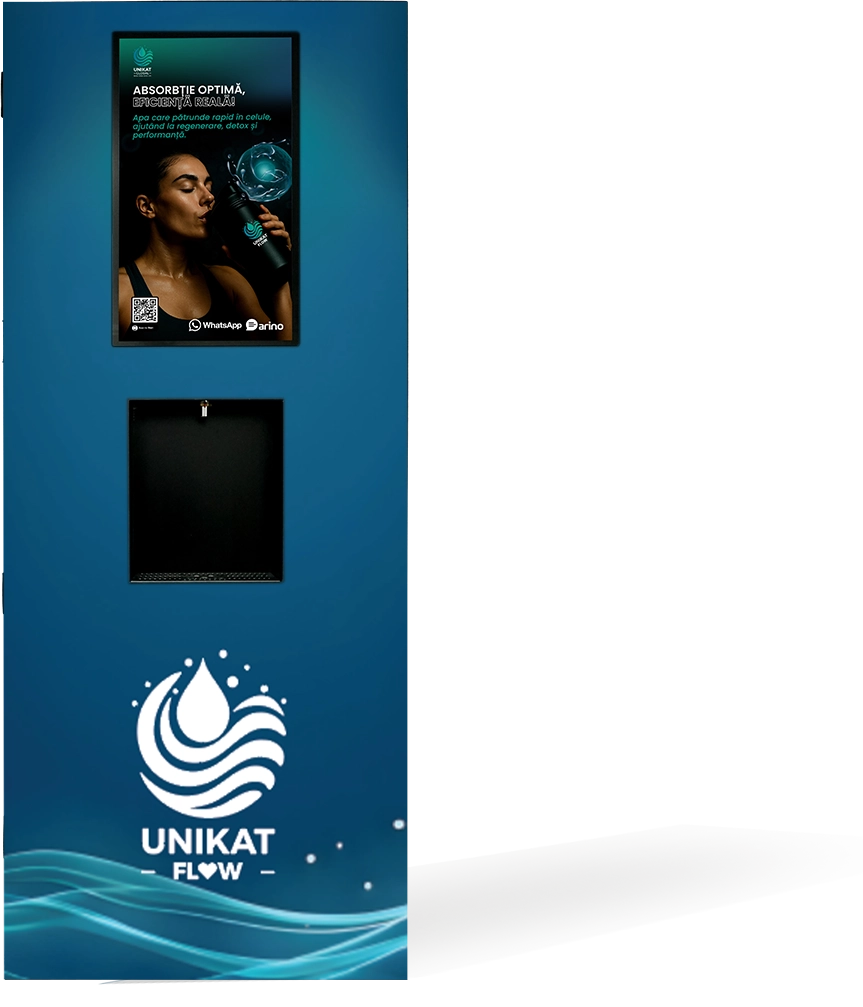
A mains-connected dispenser replaces the stream with an entirely different consumable: the filter. A filter changed at regular intervals replaces thousands of containers. The storage space disappears. Handling is reduced to scheduled maintenance. The resulting waste is the used filter, not thousands of pieces of packaging.
This logic is not a commercial preference but the order established in European waste law: preventing waste generation takes priority over recycling it. We wrote about this in the article on Directive (EU) 2019/904.
What changes the result
Four variables shift the figure significantly. If you want a calculation for your own gym, these are the numbers you need:
- Actual frequency. Three sessions a week is a commonly used average, but a performance-focused gym may see four or five, and a neighbourhood gym two.
- Consumption rate. Not every member drinks at every session. Some bring water from home. The percentage matters directly.
- Seasonality. Water consumption rises in hot weather and at peak periods. An annual average hides the peaks, which are precisely the logistical problem.
- Volume per container. 0.33, 0.5 or 0.75 litres changes the number of items at the same water volume.
What this article does not say
It does not compare water quality across sources and does not attribute any health effect to any type of water. It is a logistics and cost calculation.
Water contributes to the maintenance of normal physical and cognitive functions, at a daily intake of at least 2 litres from all sources. That is the only claim authorised in the European Union for water.
Key points
- 200 members × 3 sessions × 50 weeks = 30,000 containers a year.
- The real cost has four components, three of which never appear on the purchase invoice.
- The figure is an arithmetic estimate, not a measurement; replace the assumptions with your data.
- Waste prevention takes priority over recycling, in the order set by European law.
Sources
- Directive (EU) 2019/904 on the reduction of the impact of certain plastic products on the environment — EUR-Lex, CELEX 32019L0904
- Regulation (EU) No 432/2012 — EUR-Lex, CELEX 32012R0432