The only health claim authorised in the EU for water
In the European Union there is one authorised health claim for water: "Water contributes to the maintenance of normal physical and cognitive functions." It may be used commercially only together with its condition of use — a daily intake of at least 2 litres of water, from all sources. For molecular hydrogen there is no authorised claim at all.
What a health claim is
In European law, a "health claim" is any statement suggesting a relationship between a food and health. The framework is Regulation (EC) No 1924/2006 of the European Parliament and of the Council on nutrition and health claims made on foods (CELEX 32006R1924).
The basic rule is restrictive: a health claim may be used in commercial communication only if it has been explicitly authorised and appears on the list of permitted claims. There is no presumption of legality. What is not on the list cannot be used, however reasonable the statement sounds or however many articles repeat it.
The list of permitted claims is established by Commission Regulation (EU) No 432/2012 (CELEX 32012R0432). It is exhaustive, and each entry comes with a wording and with the conditions under which it may be used.
The claim for water
For water, the European Food Safety Authority (EFSA) assessed several proposals and issued a scientific opinion published in EFSA Journal 2011;9(4):2075, entitled "Scientific Opinion on the substantiation of health claims related to water and maintenance of normal physical and cognitive functions (ID 1102, 1209, 1294, 1331), maintenance of normal thermoregulation (ID 1208) and 'basic requirement of all living things' (ID 1207)".
On the basis of that opinion, a single usable wording entered the list in Regulation 432/2012, together with its conditions of use:
Water contributes to the maintenance of normal physical and cognitive functions.
Condition of use: the beneficial effect is obtained with a daily intake of at least 2 litres of water, from all sources.
The phrase "from all sources" changes the reading of the figure entirely. It does not mean two litres of drinking water on top of everything else you consume. It means the total water entering the body: water you drink, water in other beverages, and water contained in food. Fruit, vegetables, soups, coffee and tea all count towards that total.
What the claim does not cover
The claim refers to water, as such. It does not automatically extend to waters with particular compositions or to waters treated in a specific way. The fact that water has passed through a filter, an electrolysis chamber or a mineralisation process does not add a new claim to it and does not strengthen the existing one.
For molecular hydrogen there is, at the date of this article, no authorised health claim in the European Union. Consequently, it cannot be stated commercially that hydrogen-enriched water produces any effect on health.
Moreover, Article 10(3) of Regulation 1924/2006 also deals with non-specific claims — vague statements about general health benefits, of the "good for the body" or "supports wellbeing" kind. These are permitted only if they are accompanied by an authorised claim from the list.
The practical consequence is broader than it looks: referring to a scientific study in a commercial context falls into the same category. A heading such as "what the research says about hydrogen" placed on a product page works as a non-specific health claim. It does not stand alone.
What a water supplier may say, then
The useful distinction is between describing a process and asserting an effect.
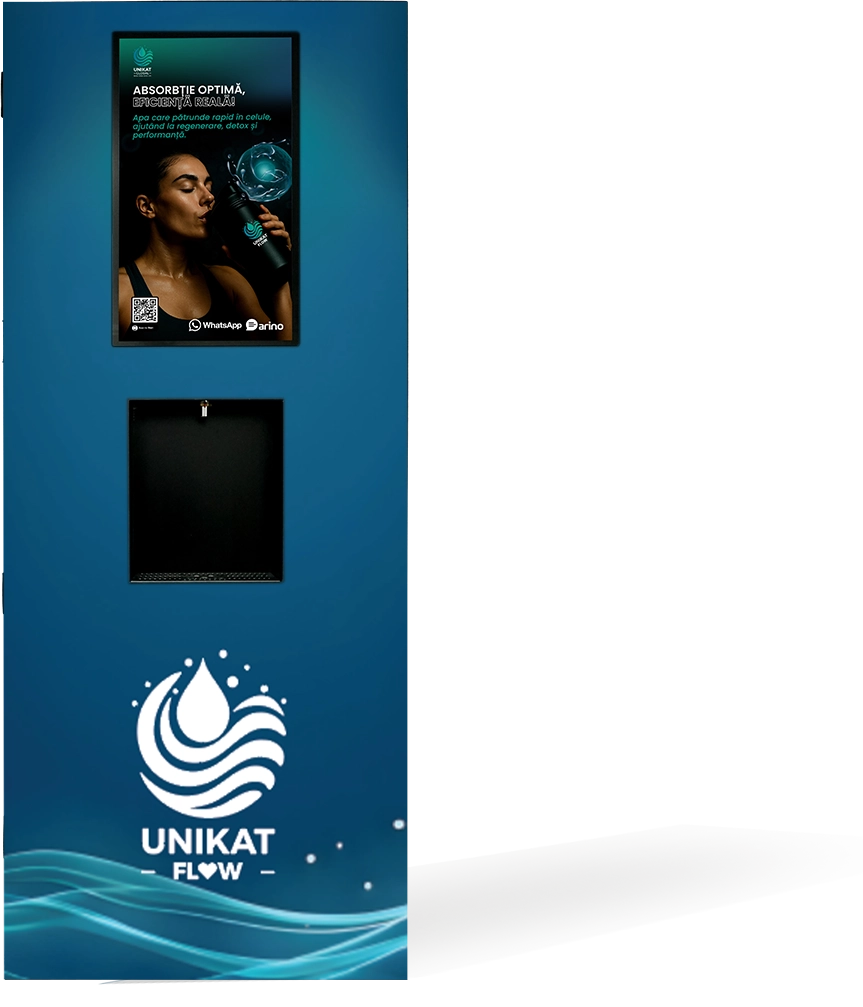
An operator installing dispensers may describe what the machine does: it filters, chills, passes the water through an electrolysis chamber, prepares it at the moment of serving. These are verifiable technical descriptions, not health claims. The operator may also describe hygiene conditions, maintenance frequency, materials used and what happens to the filters.
The operator may use the authorised claim for water, with its full condition — that is, mentioning the 2 litres a day from all sources, not just the first half of the sentence.
What the operator may not do is state, suggest or imply a health benefit attributed to hydrogen. Not directly, not by reference to studies, not through third-party quotations, not through images or symbols that suggest the same thing. The regulation covers implicit suggestion, not only explicit assertion.
Who enforces this, and what an operator risks
In Romania, compliance with the rules on consumer information and on claims made on foods falls within the remit of the consumer protection authorities and the sanitary-veterinary authority. The general consumer information framework is completed by Regulation (EU) No 1169/2011, whose Article 7 prohibits information that is misleading as to the nature, properties or effects of a food.
In practice, an operator who publishes an unauthorised benefit takes on two risks at once: a compliance risk, for the impermissible claim, and an unfair commercial practice risk, for misleading information.
Key points
- The list of authorised claims is exhaustive: what is not on it cannot be used.
- For water there is a single claim, on normal physical and cognitive functions.
- Its condition — 2 litres a day from all sources — is part of the claim and cannot be omitted.
- For molecular hydrogen there is no authorised claim in the EU.
- Citing a study in a commercial context is itself a non-specific claim.
Sources
- Regulation (EC) No 1924/2006 on nutrition and health claims made on foods — EUR-Lex, CELEX 32006R1924
- Regulation (EU) No 432/2012 establishing a list of permitted health claims — EUR-Lex, CELEX 32012R0432
- Regulation (EU) No 1169/2011 on the provision of food information to consumers — EUR-Lex, CELEX 32011R1169
- EFSA, EFSA Journal 2011;9(4):2075, doi:10.2903/j.efsa.2011.2075