The hidden cost of water bottles: transport, space, returns
The invoice for bottled water shows a single number: price per bottle, times the number of bottles. The real cost has four more components, and none of them appears on paper. Not because anyone hides them, but because they are diluted into other budgets.
1. Immobilised space
Full bottles need somewhere to sit. Empty ones, until they are collected, somewhere else. In an office or a gym, the square metre has a cost — rent, utilities, depreciation — and the space taken by packs generates nothing.
The calculation is direct: number of bottles stored at any one time × area occupied × cost per square metre. The result usually surprises people, because nobody does it.
2. Handling labour
Someone receives the delivery, checks it, stores it, carries the bottle to the machine, lifts it, mounts it, takes the empty to the return point. A 19-litre bottle weighs almost 20 kilograms.
That work is real and paid, except that it is absorbed into someone's job description — reception, administration, cleaning. Because it has no line of its own in the budget, it does not enter the price comparison.
There is also a risk component: repeatedly lifting 20 kilograms to the height of the machine is not a neutral task.
3. Gaps between deliveries
Bottled systems have a specific failure mode: they run out between deliveries. The consequence is not dramatic, but it is real — the serving point is dead exactly when it is needed, at peak hours, when consumption ran higher than the estimate.
Oversizing the stock solves that problem but increases the cost from point 1.
4. Returns
Empty bottles go back. That means a reverse logistics flow: temporary storage, coordination with the next delivery, keeping track of the containers. If they are lost or damaged, replacement costs appear.
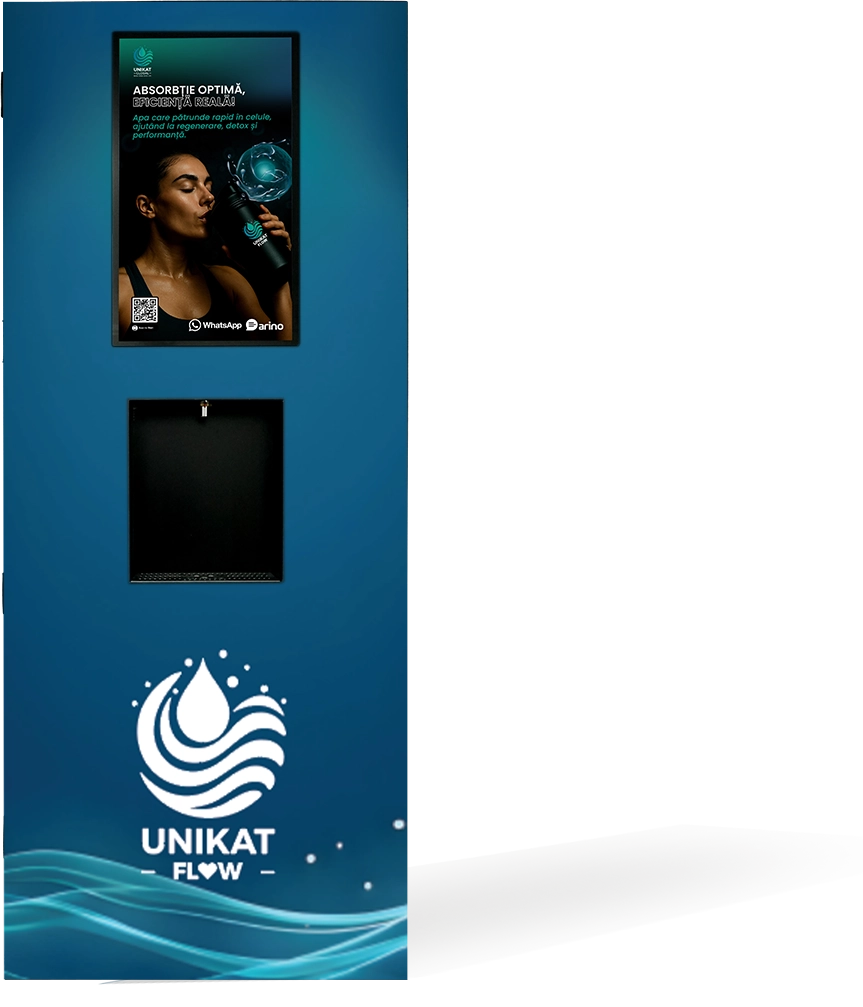
What changes with a fixed mains-connected point
All four components disappear or transform:
- space: nothing is stored
- recurring labour: reduced to scheduled maintenance, done by the supplier
- interruptions: there is no "running out"; water comes from the plumbing
- returns: there is no reverse flow
In their place appears a new consumable — the filter — changed at scheduled intervals, and a dependence on the building's plumbing.
The full comparison on criteria is in the article on bottled versus mains-connected dispensers.
How to make the comparison for your space
Do not compare price per litre. Compare total annual cost, for both options, on the same five lines:
1. the consumable (bottles or filters) 2. immobilised space × cost per square metre 3. hours of recurring labour × hourly cost 4. estimated cost of unavailability 5. removal of the resulting waste
If the supplier refuses to discuss lines 2–5, the conversation is about price, not cost.
The questions to ask before signing are collected in the article on what to ask before installing a dispenser.
What this article does not claim
It is a cost and logistics analysis. It does not compare water quality across sources and does not attribute health effects to any serving system.
Key points
- The invoice covers the consumable; the rest of the cost is diluted into other budgets.
- Storage space has a price even when it is never written down.
- A 19-litre bottle weighs almost 20 kilograms, and someone lifts it.
- Bottled systems fail in a specific way: they run out at peak hours.
- Compare total annual cost on five lines, not price per litre.
Sources
- Directive (EU) 2019/904 — EUR-Lex, CELEX 32019L0904