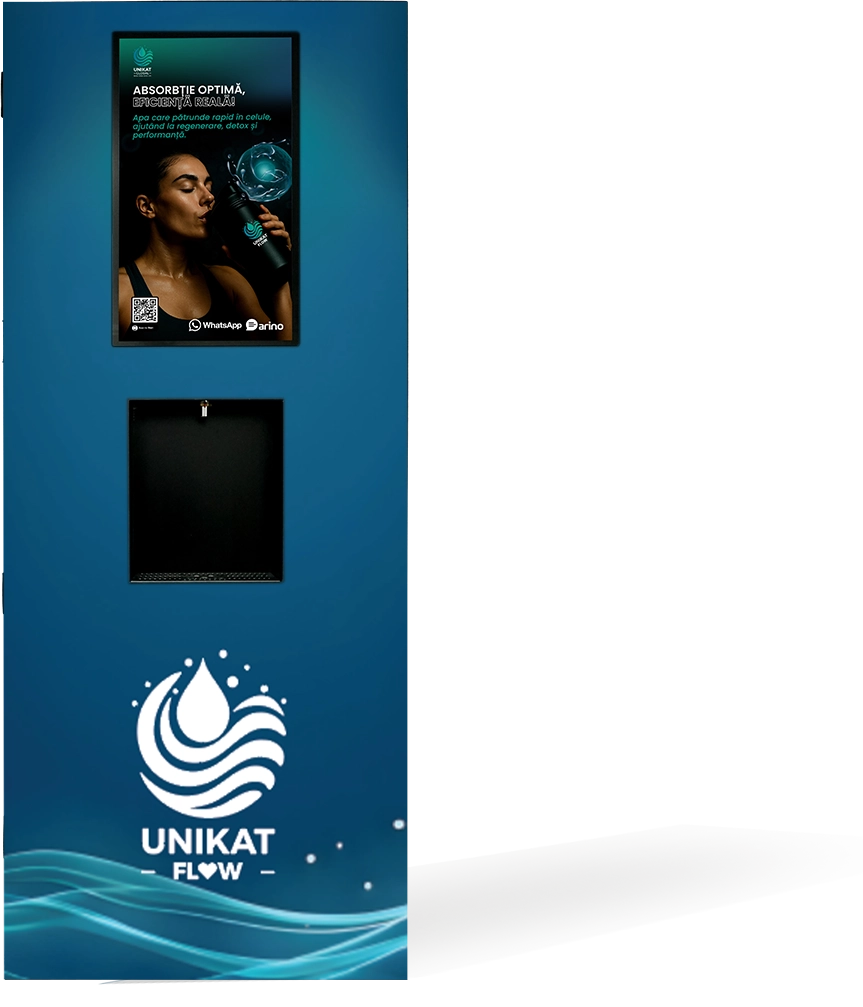
Bottled dispenser or mains-connected dispenser
The fundamental difference between the two types of dispenser is not the machine but where the water comes from. One receives water in containers delivered periodically. The other takes it from the building's plumbing and treats it on the spot. From that single difference everything else follows: logistics, space, the type of waste and the points at which something can go wrong.
The bottled dispenser
Water arrives in 10–19 litre containers, delivered periodically. The machine is essentially a stand with chilling and serving.
What it involves:
- a supplier who delivers at fixed intervals
- space for full bottles and for empties awaiting return
- a person who changes the bottle when it runs out
- dependence on the delivery rhythm: if it runs out between deliveries, the serving point is dead
The real advantage: it needs no plumbing connection. It can go anywhere there is a socket. For a space without accessible plumbing, it is the only option.
The mains-connected dispenser
Water comes from the building's plumbing and passes through a treatment chain before serving.
What it involves:
- a connection to the water supply, therefore a fixed position, chosen at installation
- consumables: the filters, changed at scheduled intervals
- periodic maintenance of the serving point
- no storage, no returns, no gaps between deliveries
The real limitation: move the machine and you need a new connection. Placement flexibility is lower than with bottles.
Comparison on criteria
| Criterion | Bottled | Mains-connected | |---|---|---| | Water source | delivered containers | building plumbing | | Storage space | yes, full and empty | no | | Possible interruption | between deliveries | a plumbing problem | | Main consumable | the bottle | the filter | | Waste generated | packaging, returned or not | used filters | | Placement | free | fixed, near the connection | | Recurring staff work | changing the bottle | none between services |
What a treatment chain actually does
For Unikat Flow dispensers, the chain is as follows: the water is filtered with zeolite and activated carbon, chilled, then passed through an electrolysis chamber with 7 titanium plates, right before serving. Nothing is added to the water.
Preparation happens at the moment of serving, not at bottling. This is a description of a process, not a statement about effects. For what can and cannot be said about water in commercial material, see the guide to checking claims.
How to choose, in practice
Three questions decide, in this order:
1. Do you have accessible plumbing where you want the serving point? If not, the discussion ends there: bottled. 2. Who does the recurring work? If you have nobody to change bottles, a system that requires it will, in practice, be empty at peak hours. 3. How much space can you afford to immobilise? Storing full and empty bottles is a hidden cost, which we set out in the article on what bottled water costs a gym.
Key points
- The substantive difference is the water source, not the machine.
- Bottles buy placement flexibility at the price of recurring logistics.
- A mains connection removes the logistics but fixes the location.
- The consumable changes: bottle versus filter.
- Neither system justifies any health claim.
Sources
- Regulation (EC) No 1924/2006 — EUR-Lex, CELEX 32006R1924
- Directive (EU) 2019/904 — EUR-Lex, CELEX 32019L0904