How to check a commercial claim about water
You do not need any chemistry to assess a commercial claim about water. You need four checks, all of them made from public documents: whether the claim is on the list of authorised claims, whether it comes with its condition of use, whether a reference to studies stands alone, and whether the wording could mislead.
Check 1: is it on the list?
In the European Union, health claims work on the principle of an exhaustive list. The framework is Regulation (EC) No 1924/2006, and the list of permitted claims is established by Regulation (EU) No 432/2012.
The practical rule: what is not on the list cannot be used. There is no grey area and no presumption of legality for a claim that merely sounds reasonable or is widely repeated.
For water there is a single authorised wording:
Water contributes to the maintenance of normal physical and cognitive functions.
For molecular hydrogen there is none. For alkaline water, none. For ionised water, none.
So: any statement about a health effect attributed to dissolved hydrogen or to a high pH is, by construction, outside the framework.
Check 2: does it come with its condition of use?
An authorised claim cannot be split in two. Each entry on the list has a condition of use that is part of the claim.
For water, the condition is a daily intake of at least 2 litres of water, from all sources.
A material that quotes the first half of the sentence and omits the condition is using the claim incompletely. And "from all sources" is not a footnote: it changes the meaning of the figure, because it includes water from other beverages and from food. That is the subject of the article on the EFSA reference values.
Check 3: does the reference to studies stand alone?
This is the check almost everyone misses.
Article 10(3) of Regulation 1924/2006 deals with non-specific claims — vague statements about general health benefits or wellbeing. They are permitted only if they are accompanied by an authorised claim from the list.
The consequence is broader than it looks. A section headed "what the studies show", placed on a product page next to the price and the buy button, works as a non-specific health claim. It does not matter that the studies cited are real and published. What matters is the commercial context in which they are invoked.
A frequent pattern in the Romanian market: a shop publishes an article about "the effects of hydrogen water", cites three or four papers from PubMed, and sells the device in the sidebar. The studies may be genuine. The construction remains a non-specific health claim without an authorised claim alongside it.
How to check: look on the page for the authorised wording, complete, with its condition. If it is not there, the reference to studies does not stand alone.
Check 4: could it mislead?
On top of the claims regulation sits Regulation (EU) No 1169/2011 on the provision of food information to consumers. Article 7 prohibits information that is misleading as to the nature, properties or effects of a food.
This test is broader than the list test, because it also covers implicit suggestion: images, symbols, comparisons, figures published without context. A pH or oxidation-reduction potential value displayed on commercial material means nothing to a buyer unless it suggests a benefit — and suggesting an unauthorised benefit falls squarely under the rule.
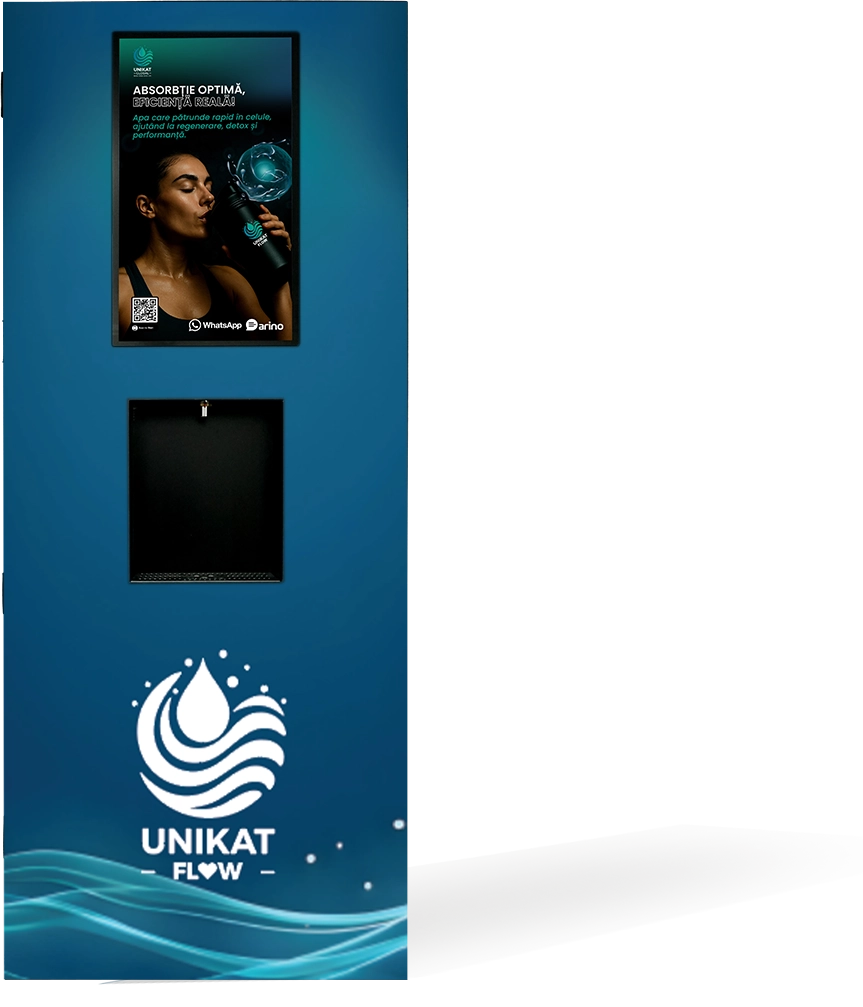
That is why Unikat Flow does not publish such values.
What remains permitted
The list of what can be said is short, but not empty:
- Describing the process. What the machine does: filters with zeolite and activated carbon, chills, passes the water through an electrolysis chamber with titanium plates, prepares it at the moment of serving. These are verifiable technical facts, not health claims.
- The authorised claim, complete, with its condition.
- Verifiable environmental facts, with the arithmetic in the open — for example, how many single-use containers a reusable container replaces in a year.
- Own measured data, with the period and location of the measurement stated.
Five questions for any supplier
1. Which authorised claim do you use, and what is its condition of use? 2. Where, on the product page, does the authorised claim appear next to the reference to studies? 3. Does this claim appear in Regulation 432/2012? At which entry? 4. Is the published figure your own measurement or an estimate? From what period and location? 5. Who established the legal classification of the product — the authority, or you?
A serious supplier answers all five without evasion. A supplier who answers "everyone says this" is, in fact, answering no.
Key points
- The list of authorised claims is exhaustive; what is not on it cannot be used.
- The condition of use is part of the claim and cannot be omitted.
- A reference to studies in a commercial context is itself a non-specific claim.
- The misleading-information test covers implicit suggestion, not only explicit assertion.
- Describing the process remains permitted; asserting an effect does not.
Sources
- Regulation (EC) No 1924/2006 on nutrition and health claims made on foods — EUR-Lex, CELEX 32006R1924, in particular Art. 10(3)
- Regulation (EU) No 432/2012 establishing a list of permitted health claims — EUR-Lex, CELEX 32012R0432
- Regulation (EU) No 1169/2011 on the provision of food information to consumers — EUR-Lex, CELEX 32011R1169, in particular Art. 7
- EFSA, EFSA Journal 2011;9(4):2075, doi:10.2903/j.efsa.2011.2075