0.8 litres per workout: what we measured in August 2026
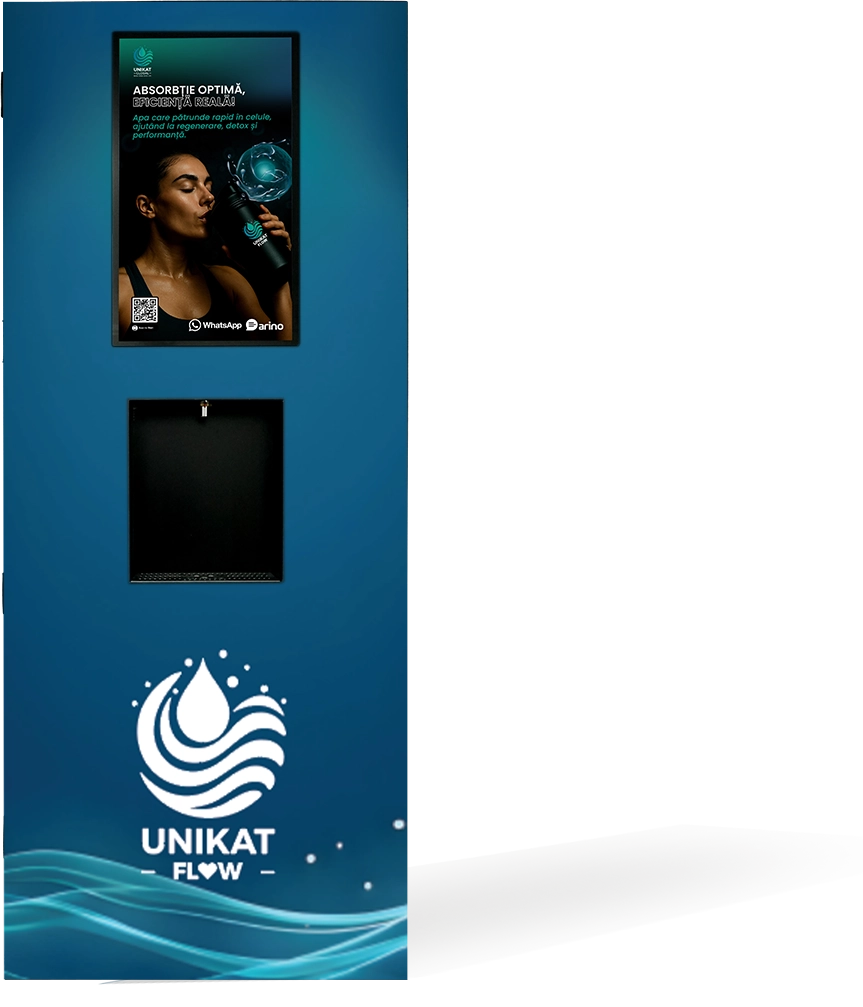
In August 2026, the average consumption measured at Unikat Flow dispensers was 0.8 litres per training session, across five clubs. It is a monthly average, over five locations, in a summer month. Below is what the figure supports and what it does not.
The figure
| | | |---|---| | Value | 0.8 litres per training session | | Period | August 2026 | | Number of locations | 5 clubs | | Unit | litres served, divided by the number of sessions | | Source | own metering at the dispensers |
The method — what is metered, what is excluded, what the limits are — is described separately, in the article on how we measure consumption at a dispenser.
What it means, concretely
Someone coming in to train takes, on average, a little under a litre of water from the dispenser.
Set against the EFSA reference values for total daily intake — 2.0 litres for women, 2.5 for men, from all sources — a training session covers a fraction of the daily intake. It does not replace the rest of the day, and it was never meant to. The details of the reference values are here.
What containers it replaces
0.8 litres per session means, in 0.5-litre single-use containers, about 1.6 containers per session.
For a consumer with three sessions a week and 50 active weeks a year, that would be around 240 half-litre containers a year, replaced by a single reusable bottle.
The calculation is arithmetic, starting from the measured figure and an assumed frequency. The frequency is not measured by us — it is a declared assumption, which you can replace with your own gym's data.
The regulatory framework for the packaging side is in the article on Directive (EU) 2019/904.
What the figure does NOT say
It is not an annual average. August is a summer month. Water consumption varies seasonally, and a winter measurement will very likely give something else. We publish August because August is what we measured.
It is not a per-location figure. It is the average across five clubs. Individual locations may be appreciably above or below the average, and their figures are not published without each partner's data and consent.
It does not describe the distribution. The average says nothing about how many members drink a lot and how many drink nothing. Two clubs with the same average can have completely different consumption patterns.
It does not transfer to offices. The consumption pattern in an office space is different: more spread across the day, without exercise-driven peaks.
It says nothing about health. Volume served is a logistical quantity. For molecular hydrogen there is no authorised health claim in the European Union.
Water contributes to the maintenance of normal physical and cognitive functions, at a daily intake of at least 2 litres from all sources.
What comes next
At the date of publication the network has ten dispensers registered with the veterinary authority — nine in Bucharest and one in Cluj-Napoca. The full list, with addresses and serial numbers, is on the locations page.
Studies of individual clubs are published as, for each one, we have a completed measurement period and the partner's consent to be named. We do not publish per-location figures without both.
Key points
- 0.8 l per session, August 2026, five clubs, own metering.
- Approximate equivalent: 1.6 containers of 0.5 l per session.
- At three sessions a week: around 240 containers a year, per person.
- It is a summer monthly average across five locations — not an annual figure and not a per-location one.
- The average does not describe the distribution and does not transfer to another type of space.
Sources
- Own metering data, Unikat Flow system, August 2026, 5 clubs
- EFSA Panel on Dietetic Products, Nutrition, and Allergies (NDA), Scientific Opinion on Dietary Reference Values for water, EFSA Journal 2010;8(3):1459, doi:10.2903/j.efsa.2010.1459
- Directive (EU) 2019/904 — EUR-Lex, CELEX 32019L0904
- Regulation (EU) No 432/2012 — EUR-Lex, CELEX 32012R0432
- DSVSA — Annex no. 17, list of food vending units operated by Unikat Global S.R.L.