What a novel food is under European law
"Novel food" does not mean, in European law, a product launched recently. It means a food that was not consumed in the Union to a significant degree before 15 May 1997. Such a food may be placed on the market only if it has been authorised and appears on the Union list. The framework is Regulation (EU) 2015/2283.
The regulation and what it replaced
The act in force is Regulation (EU) 2015/2283 of the European Parliament and of the Council of 25 November 2015 on novel foods, published in Official Journal L 327 of 11 December 2015, pages 1–22. CELEX identifier: 32015R2283.
It repealed Regulation (EC) No 258/97, the previous regime, and amended Regulation (EU) No 1169/2011 on food information to consumers. The text has been amended since; the current consolidated version dates from 27 March 2021.
The reference date: 15 May 1997
The central criterion is the history of consumption. If a food was not used for human consumption to a significant degree within the Union before 15 May 1997, it falls into the novel food category and requires authorisation before being placed on the market.
The date is not arbitrary: it is the date from which the earlier, 1997 regime applied, and the current regulation kept it as the threshold, for legal continuity.
The regulation also deals separately with foods used before that date exclusively as a food supplement: moving them into another food category is not automatically covered by that history.
The Union list
Authorisation does not work through individual approval of a company. Authorised novel foods are entered on a single list, applicable to all operators, established by Commission Implementing Regulation (EU) 2017/2470 of 20 December 2017.
For each novel food, the list specifies the designation, the conditions of use, the food categories in which it may be used, maximum levels and labelling requirements. What is not on the list cannot be placed on the market as a novel food.
The logic is the same as for health claims: an exhaustive list, not a presumption of legality.
How it is actually determined whether something is a novel food
The determination is not made by the producer, on their own, in a blog article. The regulation provides a consultation procedure: the operator applies to the Member State, which establishes the status, and in case of uncertainty the other Member States and the Commission are consulted.
For someone assessing a claim found online, the consequence is simple: the statement "this product is / is not a novel food" carries weight only if it comes from the authority, not from the seller.
Where hydrogen-enriched water sits
Here we need to be precise, because it is easy to slip.
What can be checked: molecular hydrogen does not appear on the Union list of novel foods, and it has no authorised health claim in the European Union.
What we do not assert: we do not say that hydrogen-enriched water "is a novel food" or "is not a novel food". The classification depends on the history of consumption and is established by the authority, through the procedure described above. A commercial article has no way of settling it.
One further point that is often confused: hydrogen has a recognised status as a food additive, under the code E 949. An authorised additive and an authorised benefit are, however, two entirely different things, governed by different acts. The fact that a gas may be used technologically in the food industry says nothing about health effects and authorises no statement to that effect.
Why this matters for a buyer
Three simple questions to put to any seller who invokes the legality of a product:
1. Which list does it appear on? If the answer is vague, the answer is no. 2. Which authorised claim do you use? For water there is exactly one, with its condition of 2 litres a day from all sources. 3. Who established the classification? The authority, or you?
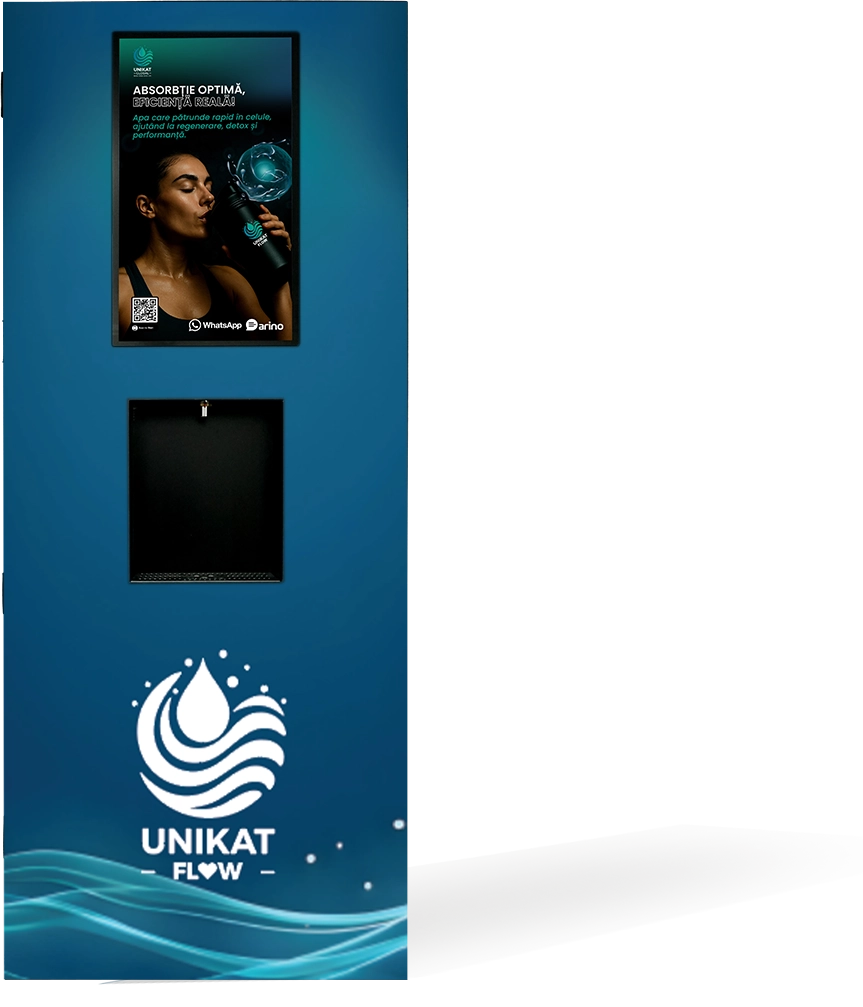
Unikat Flow describes what the machine does — filtering, chilling, passing through an electrolysis chamber, preparation at the moment of serving. It does not attribute a health effect to the process.
Water contributes to the maintenance of normal physical and cognitive functions, at a daily intake of at least 2 litres from all sources. The full framework is in the article on the only claim authorised in the EU for water.
Key points
- "Novel food" is defined by consumption in the Union before 15 May 1997, not by commercial novelty.
- Authorisation works through entry on the Union list, with explicit conditions of use.
- The list is exhaustive: what is not on it cannot be placed on the market as a novel food.
- The classification of a product is established by the authority, not the seller.
- An authorised additive (E 949) and an authorised health claim are separate legal regimes.
Sources
- Regulation (EU) 2015/2283 on novel foods — EUR-Lex, CELEX 32015R2283, OJ L 327, 11.12.2015, pp. 1–22; consolidated version 27.03.2021
- Commission Implementing Regulation (EU) 2017/2470 establishing the Union list of novel foods — EUR-Lex, CELEX 32017R2470
- Regulation (EC) No 1924/2006 — EUR-Lex, CELEX 32006R1924
- Regulation (EU) No 432/2012 — EUR-Lex, CELEX 32012R0432